Content Marketing Framework That Builds Authority and Revenue
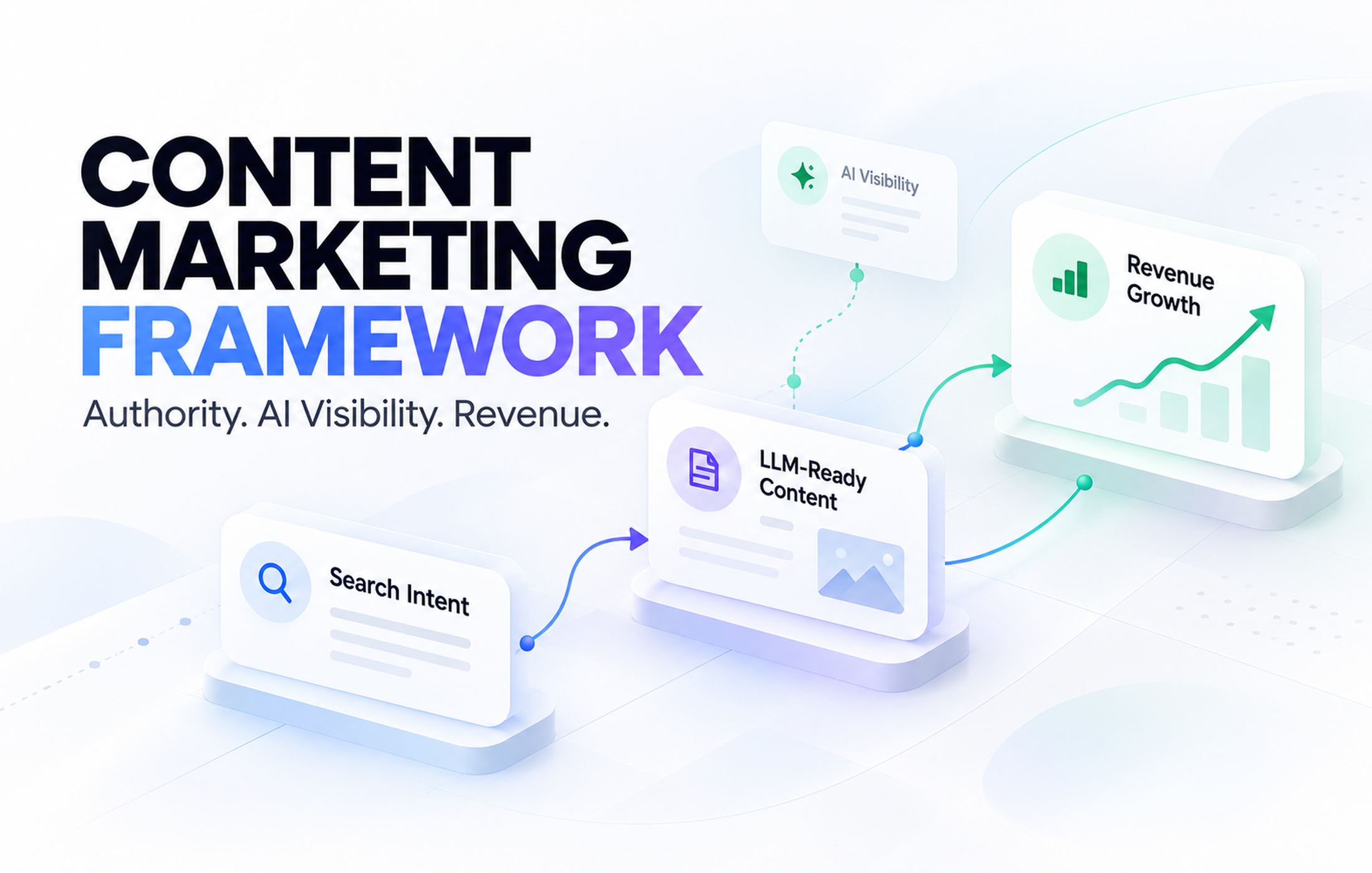
Publishing more content does not automatically create more traffic, leads, or revenue.
In fact, many brands are producing hundreds of articles every year only to watch them disappear into search results without generating a meaningful business outcome. The problem is rarely a lack of effort. It is a lack of structure.
A strong content marketing framework connects what you publish to what your buyers need, where they search, and what you want them to do next.
A content marketing framework is not a content calendar or a keyword list but a system that maps every piece of content to a specific buyer stage, a specific search intent, and a specific business outcome. Brands with this system generate leads from content consistently. Brands without it produce content that gets read once and forgotten. This guide covers how to build one that works in 2026, when Google AI Overviews and LLMs decide who gets cited and who gets skipped.
How Do You Create the Best Content Marketing Strategy?
Before writing a single word, you must know who the buyer is at each stage of their decision. What question they are asking at that stage. And what tool thy are using for their search.
In 2026, all of these matter to crack the algorithm of LLMs. Buyers are starting research inside ChatGPT, Perplexity, and Google AI Mode before they ever visit a search results page. A content strategy built only for traditional search misses the discovery moment entirely for a growing share of high-intent buyers.
AI content optimization requires structuring content so AI systems can extract, trust, and cite it confidently. Every section should open with a direct answer. Claims should be supported by specific data. Each paragraph should stand alone as a citable unit. A section that requires reading the full article to understand the point is a section that will not appear in an AI-generated answer.
Build a content strategy that performs in every environment your buyer searches in, not just the one that was dominant three years ago.
How to Structure Content for Google AI Overview Feature?
To structure content for Google AI overview, you can follow the plan below:
Lead with the answer. The first sentence under every heading should answer the question that heading poses. AI systems extract the opening lines of sections more frequently than conclusions.
Use specific, verifiable data. Vague claims are not cited. A statistic with a named source, a percentage with a context, or a named example with a specific outcome gives AI systems the factual anchoring they need to reference your content confidently.
Write in discrete, self-contained blocks. Each section should be readable and useful without the surrounding context. AI systems pull individual blocks, not full articles.
Apply schema markup. FAQ schema, Article schema, and structured data on key pages tell AI crawlers explicitly where to find extractable answers. Pages with proper schema markup appear in AI Overviews at significantly higher rates than unstructured pages.
This is how to optimize your content for LLMs!
A brand mentioned consistently in industry publications, review platforms, community forums, and third-party directories builds the entity recognition that makes LLMs confident enough to recommend it. A brand that exists only on its own website gives LLMs very little corroborating signal and very little reason to cite it.
On-site, the highest-impact optimisations are clear entity definition on your About and homepage, consistent brand description across every platform your business appears on, and content that answers questions your buyers are actually asking inside AI tools. See how Headstartt builds AI-ready content that earns citations across traditional search and LLMs simultaneously.
How Do You Turn Content Into Leads?
Content turns into leads when it creates enough trust and intent to make a buyer take a next step. Most content fails at this because it stops at information and never builds a path to action.
The conversion layer of a content marketing framework has three components. A content-to-offer connection, where every piece of content links naturally to a relevant service, guide, or consultation that deepens the relationship. A CTA that names a specific next step rather than a generic contact prompt. And a landing page or product page that continues the conversation the content started rather than resetting it.
Content strategy services built around this connection produce leads from organic traffic consistently, rather than relying on ad spend to fill the top of the funnel every month. The brands with the lowest customer acquisition costs are almost always the ones whose content is doing the heavy lifting before a buyer ever sees a paid ad.
How Headstartt Builds Content Frameworks That Drive Revenue
Headstartt builds content marketing systems for e-commerce brands that generate authority, AI visibility, and leads without depending on ad spend to sustain them. Request a strategy session today.
Content without a framework is effort without a return. At Headstartt, we build the structure that makes every piece of content compound. From pillar architecture and AI citation optimisation to conversion-focused content flows that turn readers into buyers, we build content systems that grow the business rather than just fill the blog.
The brands that will dominate organic and AI search in the next two years are building their content framework now. The window to establish topical authority before your category gets crowded is open. It will not stay that way indefinitely.