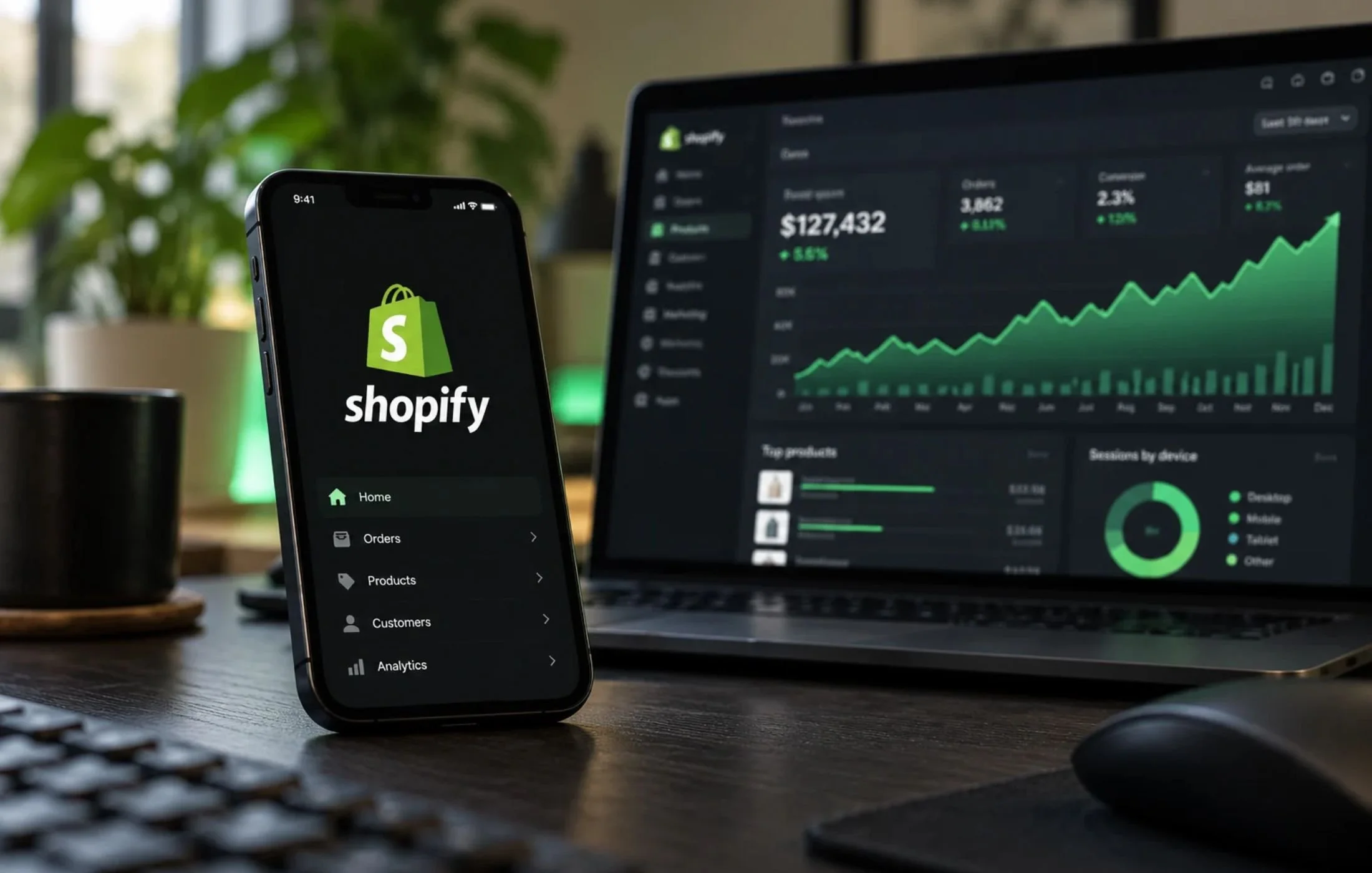
The brands winning on Shopify right now are not the ones with the largest ad budgets.
They are the ones that built a system where every layer of their store compounds on the one before it.
Traffic converts. Buyers return. Revenue grows without acquisition costs climbing at the same rate. That is the difference between a store that scales and one that just spends.
At Headstartt, we have built that system for Shopify brands across Canada and the US. This is what it looks like.
What Separates Scaling Shopify Brands From Stagnant Ones?
Shopify processed over 300 billion dollars in gross merchandise volume in 2025.
The platform holds 29% of the US ecommerce market. The infrastructure is elite. The question is never whether Shopify can scale your brand. The question is whether your brand is built to use it properly.
The stores growing efficiently share a consistent profile.
They have conversion rates above 3%. Their email and SMS flows generate 30 to 50% of total revenue.
Their product pages answer buyer objections before they form. And their brand appears in AI-generated answers before a buyer ever reaches a search results page.
The stores stagnating also share a consistent profile. Strong traffic, weak conversion, no retention infrastructure, and zero AI visibility. They are running 2022 strategies on a platform built for 2026.
Ecommerce Conversion Optimization Is Where Revenue Compounds
The average Shopify store converts at 1.4%. The top decile converts at 4.7%. That gap is not about traffic volume. It is entirely about what happens after the visitor lands.
Ecommerce conversion optimization at a technical level means auditing every friction point between intent and purchase. Product pages that bury the value proposition. Checkout flows that surface unexpected costs at the final step.
Mobile layouts designed for desktop and adapted as an afterthought. Each of these removes a measurable percentage of buyers from a funnel that costs real money to fill.
The fixes that close the gap are structural, not cosmetic.
Direct answers above the fold. Trust signals placed at the point of decision, not the bottom of the page. Guest checkout enabled.
Express payment options front and centre. Mobile-first layout built for the device that carries over 70% of Shopify traffic.
Build a Shopify store engineered for conversion at the architecture level before a single dollar of traffic is sent to it.
Ecommerce Sale Optimization Turns Transactions Into a Revenue Engine
Acquiring a customer is expensive. Keeping one is not.
Returning customers convert at three times the rate of new visitors. They have a higher average order value and a fraction of the acquisition cost.
Ecommerce sale optimization is the work of making sure the first purchase is not the last one.
The infrastructure that drives this is not complicated but most stores have not built it. Post-purchase email flows that trigger based on category and behaviour. Replenishment sequences timed to the actual product lifecycle.
Win-back campaigns that reactivate lapsed buyers before they find a competitor. When this layer is working correctly, 30 to 50% of monthly revenue comes from customers already in the database.
That is the growth engine. Paid acquisition feeds it. Retention runs it.
The brands that understand this distinction scale with margin. The ones that do not keep increasing ad spend to chase a number that should already be compounding.
Build the retention infrastructure that turns your first-purchase buyers into your most valuable asset.
AI Search Ranking Is Now a Core Revenue Channel
This is the layer most Shopify brands have not touched yet.
It is also the one that will separate category leaders from everyone else within the next few months.
When a buyer asks ChatGPT or Google AI Mode to recommend a product in your category, your store either appears in the answer or it does not. No click. No ad impression. No SEO ranking matters at that point. The recommendation has already been made.
AI search ranking depends on three things. Product data that is structured consistently across your store, your product feeds, and every third-party platform your brand appears on.
Content that answers the specific questions buyers ask before purchasing, not after. And enough third-party brand presence that AI systems have the corroborating signals to cite you confidently.
Shopify's Agentic Storefronts, introduced in Spring 2026, allow AI agents to crawl your catalogue, surface products in AI-generated conversations, and complete purchases without the buyer visiting your store directly.
Orders still process through Shopify checkout. Revenue still appears in Shopify Analytics. But the discovery happened inside an AI tool.
The brands structured for this now are building a discovery advantage that compounds monthly. The ones ignoring it are watching competitors earn recommendations they will never see attributed in any dashboard.
How Headstartt Builds Shopify Growth Systems
Growth on Shopify in 2026 is an engineering problem as much as a marketing one. Every layer of the store, from site architecture and conversion flow to retention infrastructure and AI search readiness, needs to be built with the same revenue objective in mind.
As an ecommerce marketing agency with deep Shopify expertise, Headstartt connects every discipline into one system. Shopify development and CRO.
Performance marketing, built around real unit economics.
Email and retention flows that generate revenue independent of ad spend. And AI search visibility built into the strategy from day one rather than retrofitted after the fact.
The brands scaling efficiently are not doing more. They are doing the right things in the right order with the right infrastructure underneath them.
Request a Shopify growth plan and discover what your store needs to turn more traffic into revenue, more buyers into repeat customers, and growth into something that compounds.