How Collection Pages Can Become Your Biggest Traffic Driver
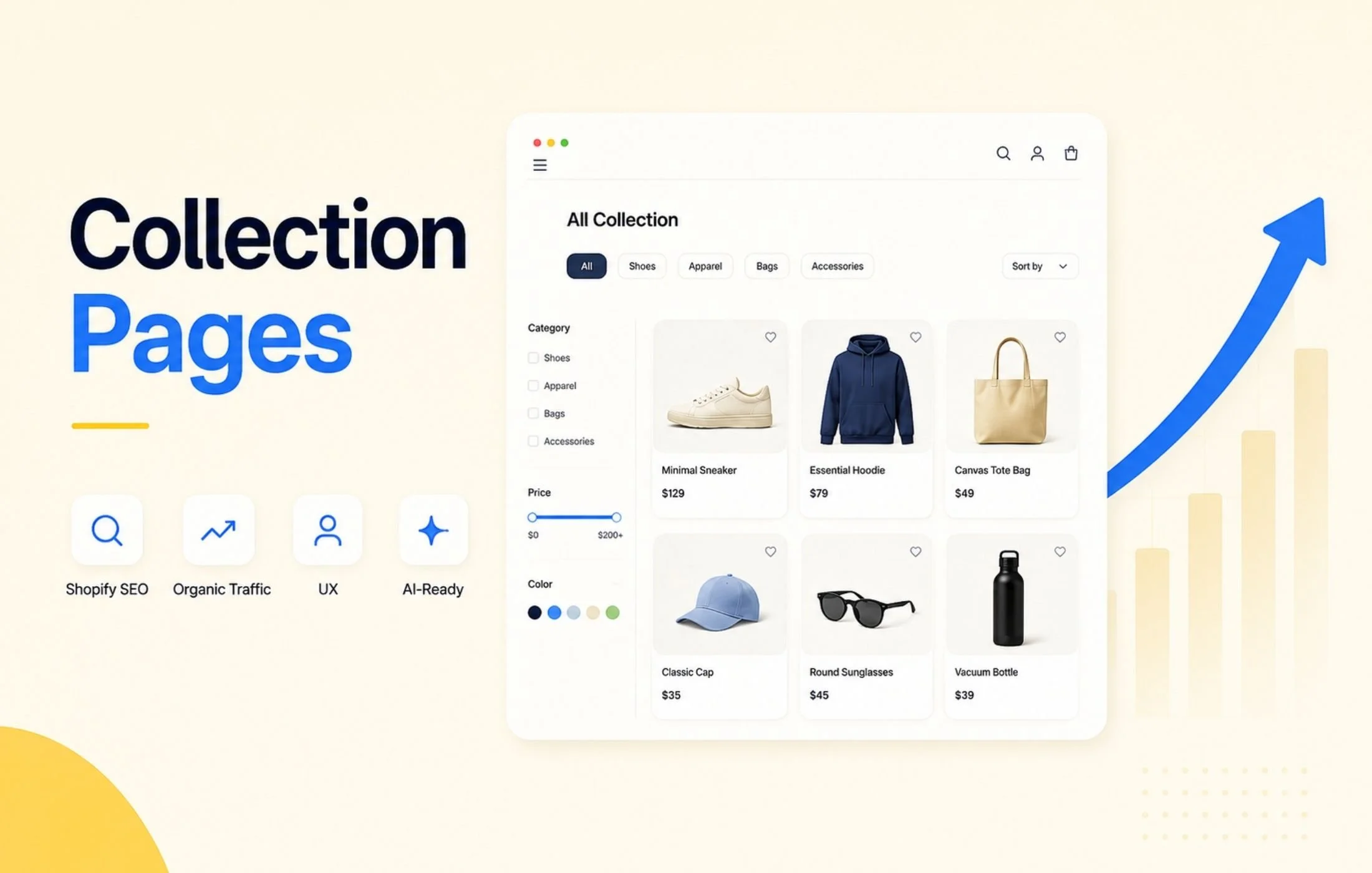
Collection pages are Shopify category pages that group related products around a specific product type, use case, or buyer search intent. Several Shopify merchants spend their SEO budget on product pages and blog content. Collection pages sit in between, mostly ignored, usually thin on content, and rarely optimised for the search terms buyers use.
That is a significant missed opportunity. Collection pages sit at the highest-intent layer of your store. A buyer searching for "waterproof hiking boots under 150 dollars" is not looking for an article. They want a curated set of products that match that query. A well-optimised collection page is the closest thing to a perfect answer.
Across the Shopify stores we work with, at Headstartt, collection pages consistently rank faster and convert at higher rates than product pages when they are built correctly. Here is the full approach.
Why Are Collection Pages Underused as an Ecommerce Organic Traffic Strategy?
Collection pages fail for a predictable reason. Most merchants treat them as organisational tools rather than search landing pages.
A default Shopify collection has a name, a grid of products, and nothing else. No description. No keyword intent. No structure that tells Google or an AI system what this page is actually for. The result is a page that ranks for the brand name at best and nothing else.
An ecommerce organic traffic strategy built around collection pages starts with one question. What does a buyer type into Google immediately before they are ready to purchase in this category? That answer becomes the foundation of the page.
Improve Your Collection Page Strategy and we will identify exactly which search queries your current collection pages are missing.
How Do You Optimize Collection Pages for SEO?
You can optimize collection pages for SEO by treating each one as a dedicated landing page for a specific buyer intent.
Start with taxonomy. Map one primary search intent per collection and build sub-collections around modifiers your buyers actually use. Color, material, use case, price range, and feature-based sub-collections each capture a separate search query with their own traffic potential. A parent collection for "running shoes" supported by sub-collections for "trail running shoes," "road running shoes," and "minimalist running shoes" captures three distinct search intents instead of one.
On-page structure follows. The H1 should be the literal collection title matching the search query. Place 50 to 100 words of keyword-rich copy above the product grid to signal relevance to crawlers immediately. Add 200 to 300 words below the grid covering buying guidance, materials, use cases, and sizing. This "double-decker" description structure keeps the shopping experience clean for users while giving search engines the depth they need.
URL handles should be short and keyword-led. Keep collection pages within three clicks of the homepage and link back to sibling collections from each page to compound internal authority across the category.
How Do You Drive Traffic to Collection Pages?
Link collection pages from your main navigation, homepage, footer, blog posts, and product templates. A "Shop more from this collection" module on product pages creates a bidirectional link structure that distributes authority both up and down the hierarchy. Point some external links and press directly to collection URLs rather than always defaulting to the homepage.
For the product grid itself, default sort order should always be best-selling. Alphabetical sort has no SEO value and poor conversion performance. On mobile, a two-column grid with pill-style filters outperforms complex layouts consistently. Sticky filters that stay visible as users scroll reduce friction on long collections and increase the probability a visitor finds what they need before leaving.
Show product counts under each filter option, allow multiple filter selections simultaneously, and surface ratings and reviews within the product card. These UX improvements reduce abandonment at the filtering stage, which is where most collection page visitors drop off before converting.
We, at Headstartt, build collection page architecture for Shopify stores optimised for both traffic and conversion.
How Do Collection Pages Appear in AI Search Results?
This is what many ecommerce marketing agency guides skip.
When a buyer asks an AI tool to recommend products in a category, the collections that appear in AI-generated answers are the ones with clear, consistent, and structured information. Vague collection pages with no descriptive content give AI systems nothing to extract or cite.
To make collection pages AI-citable, add CollectionPage and ItemList schema markup so AI crawlers can parse the page structure explicitly. Keep product attributes, pricing, and availability consistent across the collection, your product feed, and any marketplace listings. AI systems cross-reference information across sources and inconsistencies reduce citation confidence.
The descriptive copy above and below the grid serves double duty here. It gives human visitors context and gives AI systems extractable content to reference when forming a recommendation. A collection page that answers "what is this collection for and who is it best suited to" in plain language gets cited. One that shows only a product grid does not.
How Headstartt Optimises Collection Pages for Shopify Stores
Collection pages are the highest-leverage SEO asset most Shopify stores have not fully built yet. Done well, they rank faster than product pages, convert at higher rates, and increasingly appear in the AI-generated answers your buyers are reading before they ever visit a store.
At Headstartt, we build and optimise Shopify stores where collection architecture, on-page SEO, UX, and AI search readiness are treated as one connected system rather than separate projects. The stores pulling the most organic traffic in competitive categories are almost always the ones that got this right first.
Build AI-ready collection pages that appear in both traditional search and AI-generated answers.