AI-Powered Ecommerce: Trends Every Shopify Merchant Should Watch
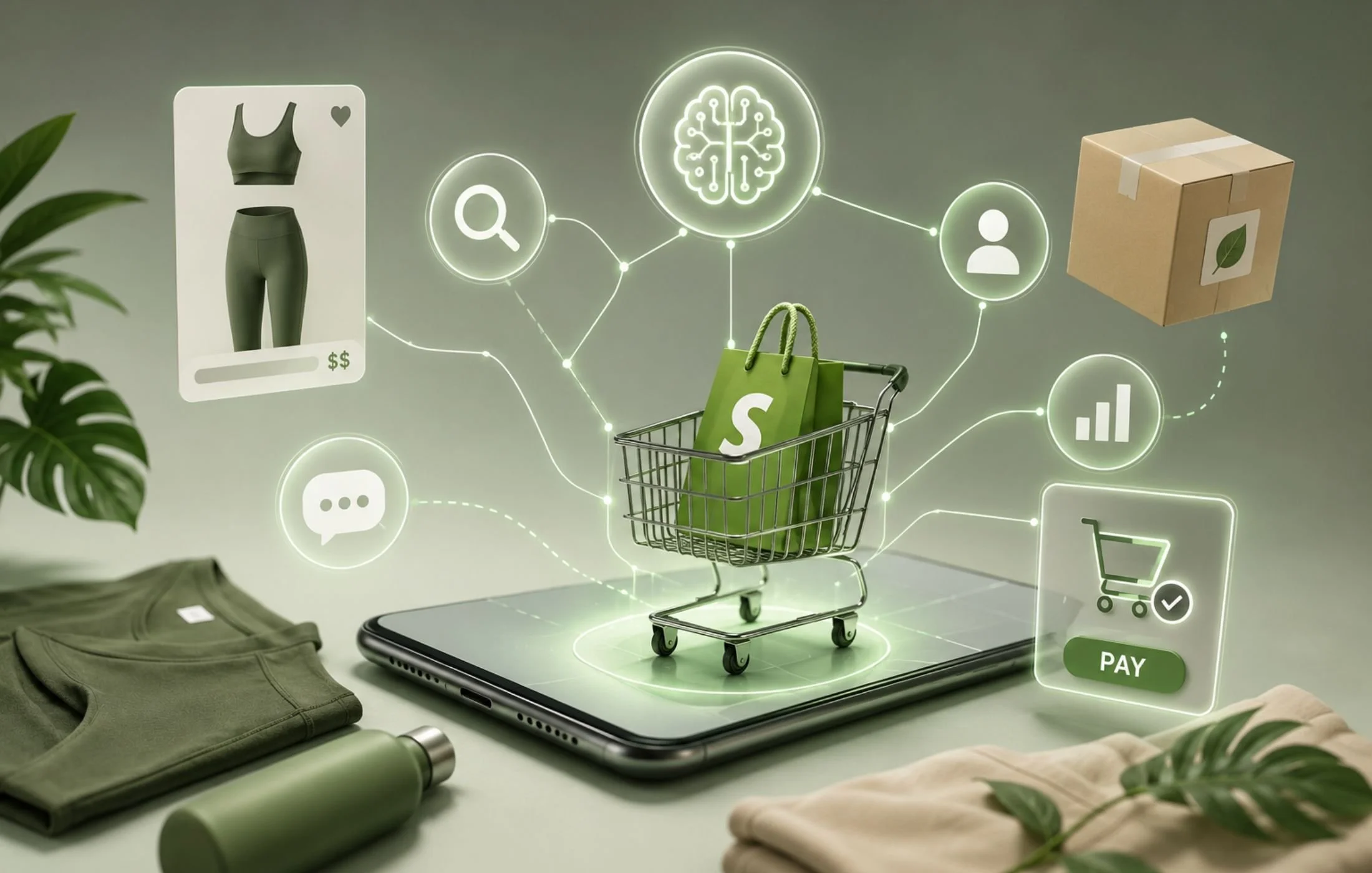
A shopper opens ChatGPT and types "best Shopify store for sustainable activewear under 100 dollars." They get three brand names, a brief reason for each, and a link to buy. No search results page. No scrolling. No comparison tabs.
Your store either appears in that answer or it does not.
That is the shift AI-powered ecommerce has brought and it is happening right now. The merchants who have figured this out are building an advantage that will be expensive to close in twelve months. The ones waiting to see how it plays out are already behind.
How Is AI Changing Ecommerce?
Shoppers are beginning product research using AI tools rather than on Google. They ask a question, get a recommendation, and click through to purchase. The discovery stage, which brands used to own through SEO and paid ads, is now being intermediated by an AI system deciding whose products are worth mentioning.
For Shopify merchants this creates two problems that both need attention. Getting found inside AI-generated answers and converting the visitors who arrive through traditional channels. Ignoring either one costs revenue quietly and consistently.
Top Ecommerce AI Trends for 2026
These ecommerce AI trends are not predictions. They are already affecting the store performance of several brands.
AI personalisation has moved from nice-to-have to a baseline expectation. Shoppers shown personalised product recommendations convert at meaningfully higher rates than those who see the same generic homepage as everyone else. Static stores are leaving revenue behind on every single visit.
Predictive inventory management is closing the gap between large and small merchants. Shopify merchant Doe Beauty saves thirty thousand dollars and four hours of manual labour weekly through Shopify Flow automations. That level of operational efficiency is not reserved for enterprise brands. It is available to any merchant willing to set it up properly.
Agentic commerce carries the most long-term weight. Shoppers are beginning to delegate purchasing decisions to AI assistants. Price drop alerts, curated gift recommendations, and reorder prompts handled by AI agents are already influencing buying decisions. The brands whose product data is structured for AI discovery are the ones getting recommended. Explore AI-Powered Shopify Solutions and find out whether your store is built for this or still catching up.
Shopify AI Integration: What Actually Changed in 2026
Shopify AI integration in 2026 is not a feature update. It is a structural change to how stores operate and sell.
Shopify Sidekick has become a genuine commerce assistant. It writes product copy, handles customer support responses, edits images, and surfaces specific performance recommendations through Sidekick Pulse. For lean merchant teams it functions as an always-available operator who never drops a task.
Agentic Storefronts are the most consequential release of this cycle. Through Shopify's Universal Commerce Protocol, your product data is structured so AI agents can crawl it, surface it in conversations, and complete purchases without the shopper ever visiting your store directly. Orders still run through Shopify checkout and appear in Shopify Analytics. Sales happen inside ChatGPT and Google AI Mode.
Campaign Autopilot handles campaign creation, scheduling, and execution automatically. For merchants running lean teams this removes one of the most time-consuming parts of scaling a store.
How Does AI Improve Ecommerce Conversions?
Through three mechanisms that each address a different stage of the buyer journey:
On-site search is first. Shoppers who use on-site search convert at 2.5 times the rate of those who browse. AI-powered search with semantic understanding surfaces the right product even when the shopper's query is vague or conversational. Shopify merchant Decked reported a 4% revenue increase after implementing Shopify Search and Discovery.
Personalised recommendations are second. When AI shows a returning customer products based on their actual purchase and browsing history rather than generic bestsellers, the path from landing to purchase shortens. Build a smarter Shopify store with personalisation built into the architecture from the start rather than added as an afterthought.
Pre-purchase support is third. Shoppers who cannot get a quick answer to a product question before buying will find a store that can. AI-powered responses through Shopify Inbox handle this around the clock without adding headcount.
AI Search Is Now a Sales Channel
When a buyer asks Google AI Mode or ChatGPT for a product recommendation, the brands that appear are not always the ones with the strongest SEO. They are the ones whose product data is clean, structured, and consistent across every platform an AI system might pull from. Shopify's Agentic Storefronts address this directly but the brand visibility layer on top of it requires separate attention.
A brand appearing in three AI-generated answers per day to high-intent queries has a compounding discovery advantage that paid ads cannot replicate at the same cost. See where your brand stands in AI search and identify the gaps before a competitor closes them first.
Turn AI Into Ecommerce Growth with Headstartt
The Shopify merchants using one or two AI features in isolation are not falling behind slowly. They are falling behind fast as competitors build AI into every touchpoint from discovery to post-purchase.
At Headstartt, we work with Shopify merchants to implement AI capabilities that connect directly to revenue. Agentic storefront readiness, brand visibility in AI search, performance marketing, and Shopify development built around how stores actually sell in 2026.
The window to build this advantage is narrowing. Turn AI Into Ecommerce Growth before your competitors claim the position first.