6 Ecommerce SEO Strategies to Boost Rankings in 2026
Most ecommerce brands treat SEO as a secondary channel. Paid ads bring immediate traffic, so budgets go there first. But long-term, scalable growth comes from visibility that compounds. That’s where ecommerce SEO strategies separate sustainable brands from short-term players.
When implemented correctly, ecommerce SEO doesn’t just increase traffic. It improves conversion quality, reduces dependency on paid ads, and lowers customer acquisition cost (CAC) over time. In competitive markets like the US and Canada, brands that consistently rank on Google don’t just win traffic — they win trust.
At Headstartt, we’ve seen firsthand how a structured ecommerce SEO strategy transforms organic visibility into predictable revenue growth.
Why Ecommerce SEO Directly Impacts Revenue
A strong ecommerce SEO strategy balances:
High-volume category keywords
Mid-funnel comparison keywords
High-intent product-level searches
This layered approach creates consistent traffic across the buying journey.
In addition, Google now ranks websites using mobile-first indexing. That means your mobile performance, readability, navigation, and loading speed directly impact visibility.
Organic rankings build brand authority and authority increases click-through rates, which improves rankings further.
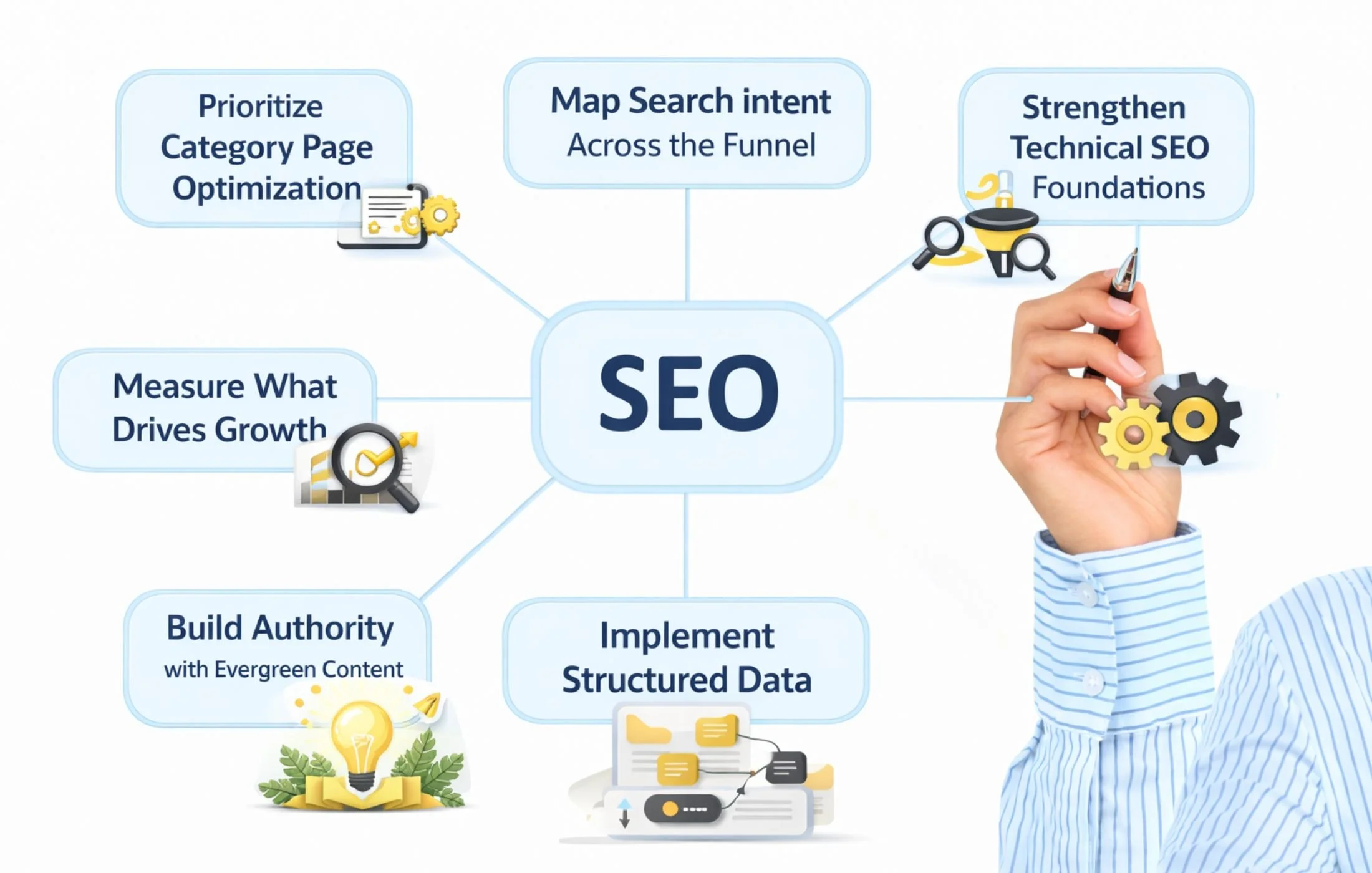
Let’s break down the six ecommerce SEO strategies that drive measurable results.
1. Prioritize Category Page Optimization
Category pages are often the biggest missed opportunity in ecommerce SEO.
Most brands focus heavily on blog content but ignore their commercial pages. However, category pages target high-intent, high-volume keywords that directly influence revenue.
Use clean, keyword-focused URLs
Include internal links to top products
Optimize title tags and meta descriptions for clicks
For example, a well-optimized “Men’s Running Shoes” page can rank for multiple variations beyond the main keyword. Strong category pages often become long-term traffic drivers.
2. Map Search Intent Across the Funnel
Not all keywords serve the same purpose.
A high-performing ecommerce SEO strategy segments keywords into intent groups:
Blog posts and guides capture informational searches
Comparison pages and optimized categories capture commercial searches
Product pages capture transactional searches
Brands that target only transactional keywords miss early-stage buyers. Covering the full intent funnel builds stronger topical authority and improves overall rankings.
3. Strengthen Technical SEO Foundations
Technical SEO is often invisible but it determines whether your content performs at all.
Key areas to optimize:
Mobile responsiveness
Core Web Vitals (page speed, layout stability, interaction time)
Logical site hierarchy
Crawlable internal linking
Canonical tags for filtered pages
Faceted navigation (filters for size, color, brand) should be carefully managed. If search engines index every parameter variation, it creates duplicate content and wastes crawl budget.
Even small technical improvements like faster load speed can directly impact both rankings and conversions.
4. Implement Structured Data for Visibility
Structured data helps search engines interpret your content accurately.
For ecommerce stores, Product schema is critical. It allows you to highlight:
Price
Availability
Ratings
Reviews
Brand
This increases your chances of appearing with snippets in search results, improving click-through rates.
Rich snippets showing price and ratings make your listing stand out and increase click-through rates without increasing ad spend.
5. Build Authority with Evergreen Content
SEO compounds when authority compounds.
Instead of publishing random blog posts, create evergreen assets that deserve links.
Examples:
Comprehensive buying guides
Product comparison breakdowns
Data-backed industry insights
“Best of” curated category pages
Internal linking from blogs → category pages → product pages distributes authority effectively.
A single strong buying guide can attract backlinks for years, strengthening your entire domain and helping product pages rank faster.
6. Measure What Actually Drives Growth
Tracking rankings alone isn’t enough.
A revenue-focused ecommerce SEO strategy measures:
Organic revenue
Conversion rate by landing page
Revenue per organic visitor
Share of voice across keyword clusters
Organic contribution to total sales
SEO should not exist in isolation. It should integrate with your paid acquisition strategy to improve blended CAC and overall marketing efficiency.
Tracking revenue impact — not just rankings — ensures your ecommerce SEO strategy stays aligned with business goals.
Build a Revenue-Focused Ecommerce SEO Engine with Headstartt
Ecommerce SEO is not about keyword stuffing or publishing high volumes of content. It’s about building a structured, data-driven system aligned with revenue goals.
At Headstartt, we help ecommerce brands design performance-driven SEO frameworks that improve rankings, increase qualified traffic, and reduce long-term customer acquisition costs.
From technical audits and category optimization to structured data implementation and authority-building content strategies, our approach focuses on outcomes.
If you're ready to build organic visibility that compounds over time, explore how Headstartt approaches ecommerce growth, or Request a Quote to discuss a tailored SEO roadmap for your brand.
FAQs
1. What are ecommerce SEO strategies?
Ecommerce SEO strategies are techniques used to help online stores rank higher in search results and attract high-intent buyers.
2. Why is ecommerce SEO important in 2026?
In 2026, search and AI-driven discovery dominate online shopping, making SEO essential for long-term visibility and sales growth.
3. How long does ecommerce SEO take to work?
Most ecommerce stores see noticeable results within 3–6 months, depending on competition and technical health.