Vanity Metrics vs Real Growth: What Actually Drives Revenue
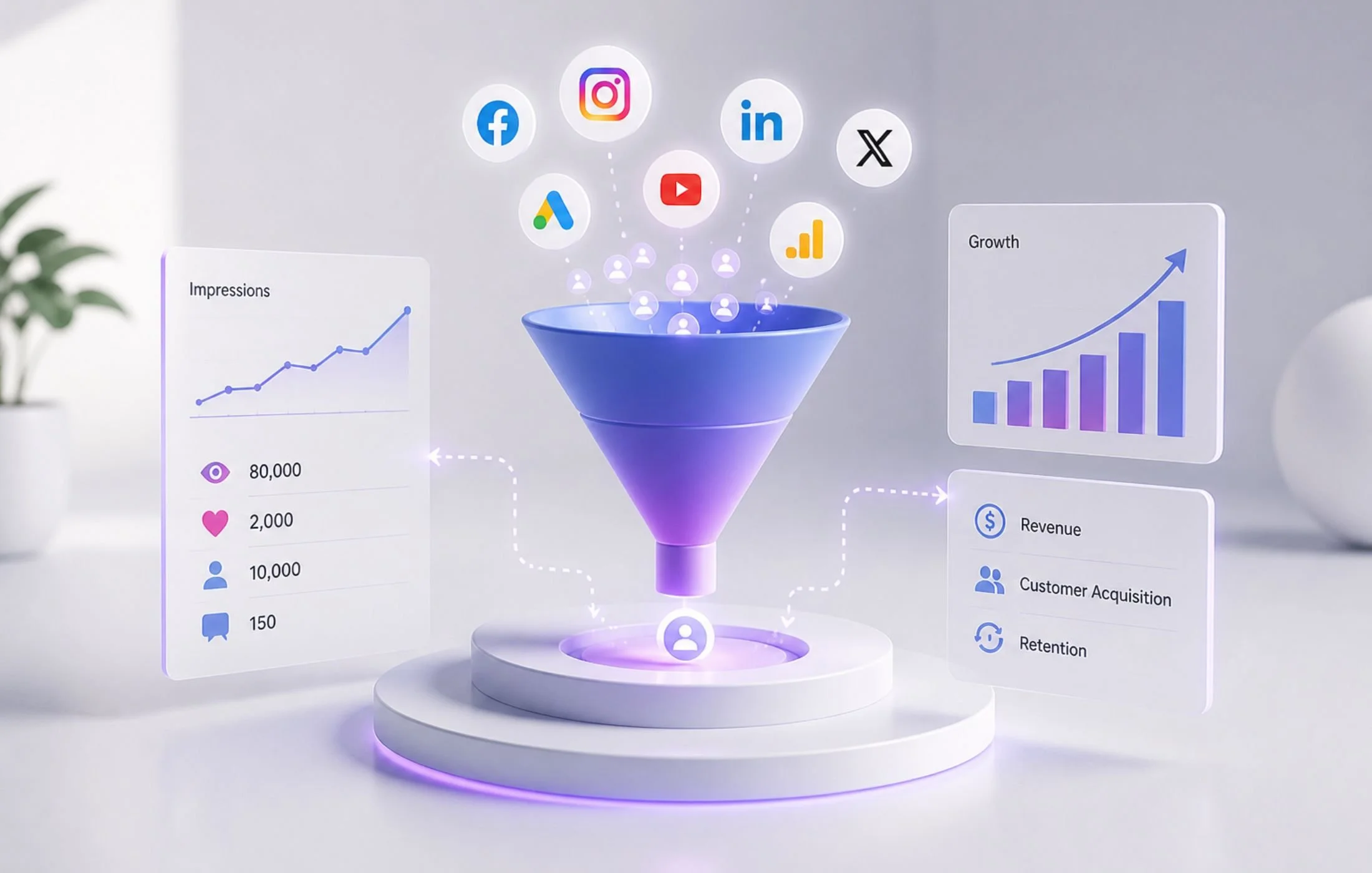
Your last campaign got 80,000 impressions. Your Instagram following jumped by 2,000 this month. The post you boosted last week hit 400 likes. The report looks great and the room nods along. Then someone asks how many leads came in, and the energy shifts.
This is a conversation happening in marketing meetings across Canada every single week. Numbers that look like progress but do not connect to anything that actually grows the business. That is the vanity metrics problem. It is more common than most teams want to admit.
At Headstartt, we have sat across from enough business owners and marketing leads to know that this is one of the most expensive blind spots in Canadian marketing today.
What Is a Vanity Metric?
What is a vanity metric? It is any data point that looks impressive on a dashboard but cannot be tied to a real business outcome like revenue, customer acquisition, or retention.
Page views, follower counts, total impressions, email subscriber numbers, and social media likes are the usual suspects. None of them is useless in every context, but all of them become dangerous when treated as proof that something is working. According to Forbes, 41% of marketing KPIs currently being tracked by businesses fall into this category. That means nearly half of what most teams measure doesn't tell them anything that matters.
The reason these metrics persist is straightforward. They are visible, they update in real time, and they move in the right direction often enough to feel like momentum. Platforms surface them by default. They are easy to screenshot and put in a slide deck. But easy to report is not the same as useful to act on.
Which KPI Is Most Likely to Be a Vanity Metric?
Which KPI is most likely to be a vanity metric? Social media followers, consistently. A brand can gain 10,000 followers overnight through a giveaway and see zero movement in sales, leads, or website conversions the following month. Follower count measures popularity at a surface level. It does not measure intent, interest, or purchasing behaviour.
Close behind followers are total impressions and raw page views. An impression is recorded even when someone scrolls past your ad without registering it consciously. A page view tells you someone landed on a page, but says nothing about what they did next or whether they were ever going to buy from you.
The test for any KPI is simple. Ask yourself what decision you would make if that number doubled tomorrow. If the answer is unclear, the metric is not doing its job. Explore multiple possibilities for your brand with our team and we will audit exactly what your current reporting is and is not telling you.
Vanity Metrics Examples Canadian Businesses Should Recognise
Here are the most common vanity metrics examples that our team at Headstartt comes across in Canadian marketing reports right now, and what to track instead.
High website traffic with a low conversion rate is one of the most misleading combinations in digital marketing. 50,000 monthly visitors means very little if 49,500 of them leave without taking any action. The metric worth tracking is conversion rate by channel and by page, not total traffic volume.
Email subscriber count without open rate segmentation is another. A list of 20,000 subscribers that opens at 8% is significantly less valuable than a list of 5,000 that opens at 35% and clicks through consistently. List size is a vanity metric. Revenue attributed to email is not.
Bounce rate on its own is largely meaningless. A user who lands on a page, reads everything, and leaves because they got exactly what they needed still counts as a bounce. The metric worth examining is time on page, combined with the action taken before or after the visit.
Total ad impressions without return on ad spend attached tell you your ad was seen, not that it worked. A campaign generating 2 million impressions and 14 conversions is not a successful campaign. It is an expensive one.
What You Should Be Tracking Instead
The metrics that connect to revenue share one quality. They answer the question of what happened because of this. Not how many people saw it, but what did they do and what did it cost to get them there.
Customer acquisition cost tells you how much you are spending to bring in each new paying customer. Paired with customer lifetime value, it tells you whether your growth engine is sustainable or burning cash faster than it is earning. Most Canadian businesses track neither with any precision.
Conversion rate by channel shows you which platforms are actually sending buyers versus browsers. A channel with lower traffic but a 6% conversion rate is worth more than one driving triple the volume at 0.8%.
Return on ad spend is the clearest signal in paid marketing. If you are spending 5,000 dollars a month on ads and cannot attribute revenue directly to that spend, the problem is not the budget. It is the measurement setup.
Pipeline velocity, for B2B businesses specifically, tells you how fast leads are moving through your sales process and where they are stalling. A slow pipeline is a solvable problem when you can see where it breaks down. It is invisible when you are only counting lead volume at the top.
Why This Problem Keeps Happening?
Tracking vanity metrics is rarely a deliberate choice. It happens because the right metrics are harder to set up, harder to explain to stakeholders, and harder to defend when they dip. Impressions only go up. Conversion rate tells the truth.
Only 23% of marketers say they feel confident they are tracking the right KPIs. That means the majority of marketing teams in Canada and globally are building strategies on incomplete or misleading data. Campaigns get scaled that should be cut. Budgets get pulled from channels that are actually working because the numbers being reported do not show the full picture.
The shift from vanity reporting to revenue reporting requires two things. A clear agreement on what the business is actually trying to achieve and a tracking setup that connects marketing activity to those outcomes at every step of the funnel.
How Headstartt Builds Reports That Drive Better Decisions
At Headstartt, we do not hand clients dashboards full of numbers that look impressive in a monthly review. We build reporting frameworks around the outcomes the business cares about, whether that is qualified leads, cost per acquisition, revenue per channel, or customer retention rate.
Every campaign we run is measured against metrics that can be acted on. If something is not moving a number that connects to revenue, we say so directly, and we change the approach. That is what experienced performance marketing looks like. It is the standard every Canadian business deserves from their agency.
If your current reporting leaves you wondering whether your marketing is actually working, chat with us and let's replace your fear and assumptions with numbers that tell the truth.